Great Danes in Art: An Artist's Perspective
As an art lover and creative soul, I am fascinated by the majestic Great Dane not only as a living being, but above all as a timeless motif in visual arts. These gentle giants have inspired artists throughout the centuries and are far more than just breeding objects – they are living sculptures immortalized in countless works of art.
The historical roots: Great Danes as aristocratic companions
Renaissance and Baroque Splendor
In the Baroque period, a deeper symbolism developed around the depiction of dogs in art. Great Danes embodied loyalty, vigilance, and steadfastness - virtues that were particularly valued in aristocratic portrait painting. This symbolic charge made them popular motifs in family portraits and representative paintings.
The 19th Century: Individualization of Animal Personality
A remarkable turning point in the artistic representation of Great Danes marks the 19th century. Wilhelm Trübner's famous painting "Seated Great Dane" (1877/78) shows his own Great Dane "Caesar" no longer as a symbol, but as an individual with independent personality. Preserved in the Neue Pinakothek Munich, the work presents the Great Dane in full size, "half surprised, half expectant," and reveals "very individual, almost human character traits of the super dog."
Trübner created an entire series of works with Caesar, including the humorously titled "Great Dane with Sausages on the Nose" and "Caesar at the Rubicon." This anecdotal representation and the "subtle skepticism" in the animal's features show a completely new approach to animal painting - away from pure status symbol toward emotional character study.

Modern Interpretations: Pop Art and Contemporary Art
The Pop Art Revolution
The 20th century brought a radical reinterpretation of dogs in art. Artists like Andy Warhol and David Hockney elevated pets to Pop Art icons. Warhol, who immortalized his dachshunds Archie and Amos in bright colors, showed that animals can be just as artistically valuable as human portraits.
David Hockney's "Dog Days" (1993-1995) with his dachshunds Stanley and Boodgie became a milestone in modern animal painting. His hundreds of drawings and paintings of the two dogs were created during a time of personal grief and showed the therapeutic power of art in the human-animal relationship.
Great Danes in Contemporary Art
Today, Great Danes are experiencing a renaissance in contemporary art. Modern artists interpret them in Pop Art aesthetics with bright colors and expressive brush techniques. Online platforms like Etsy show an abundance of Great Danes in colorful wall art, often with sunglasses and ironic elements that illustrate the playful treatment of the traditionally aristocratic image of the breed.

Street Art and Urban Reinterpretation
Great Danes Conquer the Streets
A particularly fascinating development is the integration of Great Danes into Street Art. Graffiti artists have adapted these majestic dogs as symbols of urban strength and gentle giants. The contrasts between the traditionally aristocratic association of the breed and the rebellious nature of street art create tension-filled artworks.
Street Art with Great Danes often shows socially critical aspects - the size and imposing nature of the dogs is used to convey messages about power, protection and social hierarchies. This urban art democratizes the traditionally elitist motif and makes it a symbol for all social classes.

Art Techniques and Modern Approaches
Diversity of Artistic Media
The range of art techniques for Great Dane representations is greater today than ever before. From traditional oil painting to digital art, artists find ever new ways to depict these impressive animals. Pastel chalk enables soft, natural textures, while acrylic painting allows vibrant, modern interpretations.
Popular Art Techniques for Great Dane Portraits:
- Oil Painting: Detailed, realistic representation with warm tones
- Acrylic Painting: Vibrant colors and modern, experimental approaches
- Pastel Chalk: Soft transitions and natural textures
- Digital Art: Versatile effects with Pop Art influences
- Street Art: Urban, expressive and socially critical
- Sculpture: Monumentality in bronze or decorative ceramics
Contemporary artists like Melanie Januszok use pastel crayons for "breathtaking animal portraits" that reflect the uniqueness of each individual animal. The technique allows capturing both the physical presence and the emotional depth of these gentle giants.

Sculpture and Three-Dimensional Art
Great Dane sculptures have a long tradition, from classic bronze works to modern ceramic figures. Malcolm Thompson, a British artist, has specialized since 1991 in life-size Great Dane sculptures and created affordable stone statues for breeders and enthusiasts. His works "radiate and reflect the character of this wonderful Great Dane breed."
Symbolism and Artistic Significance
More Than Just a Dog
In art, Great Danes embody far more than their physical appearance. They are symbols of loyalty, strength and gentle power. Their imposing size combined with a tender character makes them perfect metaphors for apparent contradictions in human nature.
The anthropomorphization of Great Danes in art - from Trübner's individualized portraits to modern humanized representations - reflects our need to recognize and celebrate human qualities in animals.
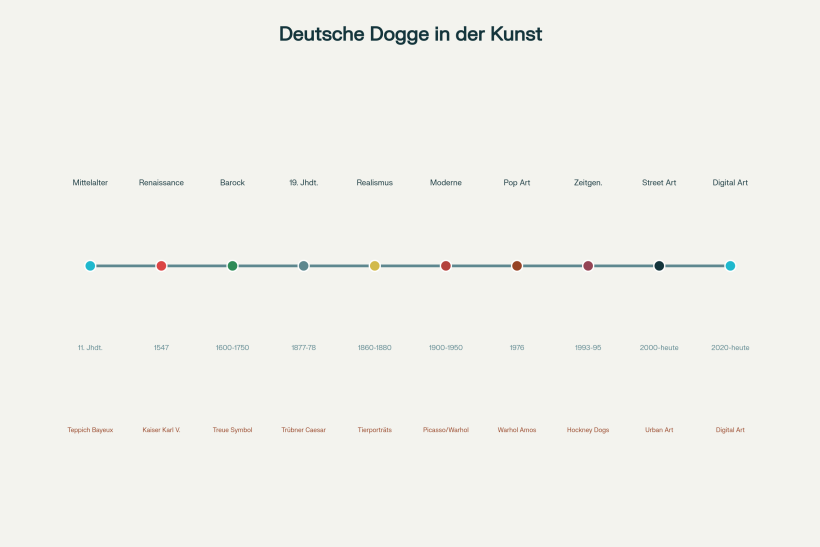
Artistic Development of Great Dane Representation:
- Middle Ages: First depictions as hunting companions
- Renaissance (1547): Representative portrait style with Emperor Charles V
- Baroque: Symbols of loyalty and vigilance
- 19th Century: Individual animal characterization by Trübner
- Pop Art (1976): Dogs as Pop Art icons by Warhol
- Contemporary: Street Art and digital interpretations

Inspiration for Artists Today
Why Choose Great Danes as an Art Motif?
From an artistic perspective, Great Danes offer unique challenges and rewards:
Physical Aspects:
- Monumental proportions demand large-format works
- Elegant lines between power and grace
- Expressive face with deep-set, intelligent eyes
- Diverse color variations from black through blue to spotted
Emotional Dimensions:
- Gentle Giant Paradox: Imposing meets tenderness
- Loyalty and devotion as universal themes
- Dignity and serenity in posture
- Human character traits in animal form
Practical Tips for Great Dane Artists
Composition and Perspective:
- Use the natural size for dramatic visual impact
- Low camera position emphasizes the majestic appearance
- Profile views show the elegant lines optimally
- Close-ups of the face reveal the personality
Color Design:
- Warm earth tones for classic elegance
- High-contrast black-and-white studies for dramatic effect
- Pop Art colors for modern interpretations
- Pastel tones for soft, emotional representations
Conclusion: Great Danes as Timeless Art Motifs
Great Danes have conquered their firm place in art history - not as mere breeding objects, but as a living source of inspiration for artists of all epochs. From the aristocratic portraits of the Renaissance through the emotional character studies of the 19th century to the colorful Pop Art and rebellious Street Art of the present - these majestic dogs remain an inexhaustible motif for creative engagement.
As an artist, I see in Great Danes the perfect synthesis of power and grace, of tradition and modernity. They embody values that are timeless in art: loyalty, dignity and the beauty of the living. In a time when art is increasingly becoming digital, these gentle giants remind us that the most beautiful artworks often arise from direct encounter with life.
For aspiring artists, the Great Dane is an ideal motif to develop both technical skills and emotional depth. The challenge of uniting their imposing appearance with their gentle nature makes every stroke a meditation on the complexity of life itself.
This article arose from an artist's passion for the majestic Great Danes and their diverse representation in art history. From historical paintings to contemporary Street Art - these gentle giants inspire creatives worldwide.